

The Ten-Second Price Test: Can a Stranger Get a Real Number Off Your Website?
Open your own website on your phone. Pretend you have never seen it before. Start a timer and try to find out what you charge.
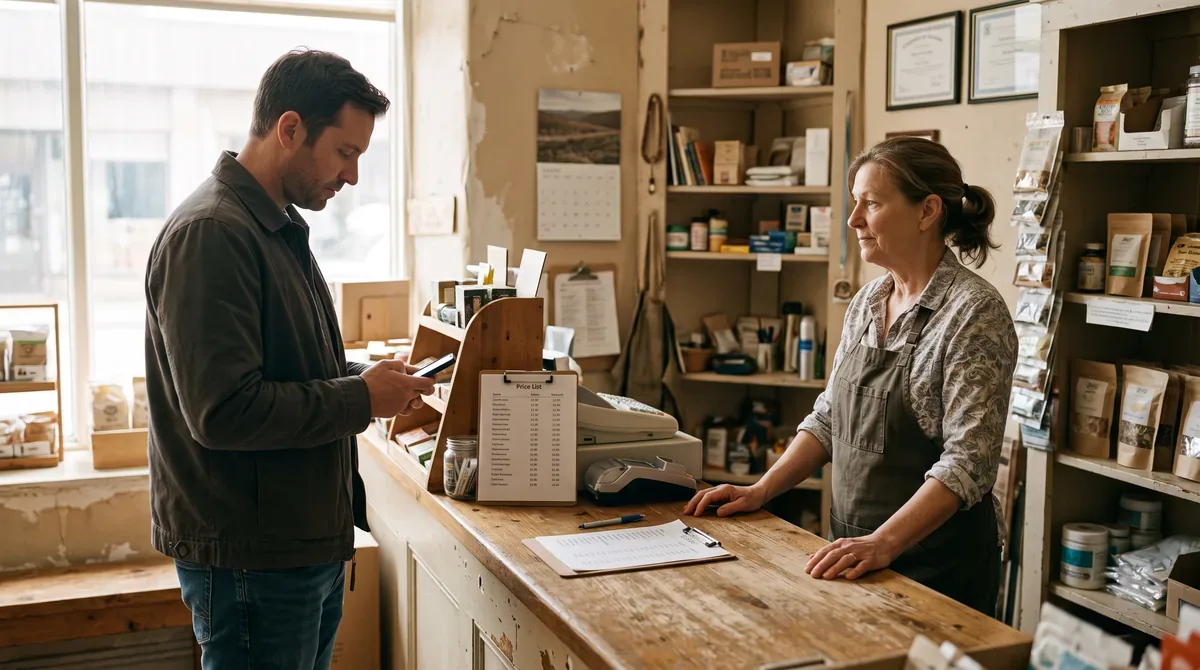
Plenty of owners cannot do it in ten seconds. Some cannot do it at all, because the number was left off on purpose, for a reason that sounded sensible at the time. Every job is different. We would rather talk to people first. Our prices change.
The stranger holding the phone has four other tabs open, and every one of them is a business like yours.
What the stranger is actually doing
They are not hunting for the cheapest option. They are sorting. Sorting happens before buying, and it is brutal, because it is done quickly and on very little information.
Someone comparing four dental practices for a crown is working out which of the four are in their world at all. Someone looking at guesthouses for a long weekend is working out which ones they can afford before they look at the photographs properly. If your site gives them nothing to sort on, you do not stay on the list as an intriguing mystery. You come off it.
Why “it depends” is not a reason to say nothing
Of course it depends. A plumber cannot price a leak from a web page. A guesthouse rate moves with the season. An attorney’s work varies by matter. None of that stops you putting a number on the page with a shape around it.
A plumber can write that the call-out is R650 and covers the first hour, and that most blocked drains are finished inside it. A guesthouse publishes from R1 450 a night for two out of season and R2 100 in December. Even the most variable work in a dental practice can be written down honestly: a check-up and clean is R780, while a crown runs between R6 500 and R9 500 depending on the material, with the exact figure confirmed after the X-ray.
Every one of those is honest. Every one of them lets a stranger decide whether to carry on, which is all you wanted from the page.
The ten seconds matter as much as the number
A price that exists but cannot be found is the same as no price. The usual hiding places are a PDF rate card, an image of a price list that a phone renders too small to read, a pricing page that lists packages without figures, and a “contact us for a quote” form standing where the number should be.
The number belongs on the page about the thing it prices, near the top, written as text. Not in the footer. Not on a separate page called Investment. If someone has landed on your page about geyser replacements, that is the page where the geyser replacement price lives.
What should sit directly underneath it
A price on its own is half a page. The moment a visitor sees a figure they can live with is the moment they are most willing to act, and most sites spend that moment asking them to scroll.
Put the next step right there. Book the slot. Request the date. Ask for a call-out on Tuesday. If the next step is a form, keep it short enough to finish standing up in a queue at the till.
Run the test properly, on someone else
You cannot run this on yourself, because you know where everything is. Ask someone who does not work for you and has never used your site. Hand them your website on their own phone, on their own data, and ask them to find out what you charge for your most common job.
Then watch without helping. The urge to help is enormous and it ruins the test. Count the seconds, and write down the exact point where they stopped, went back, or gave up. Then do the same with two competitors and compare the three times.
If you truly cannot publish a price, publish the cost of finding out
Some work cannot be priced without being seen. A roof. A matter that may or may not go to court. A kitchen fit-out. The page still has a job to do, and the job is removing the uncertainty that stops somebody picking up the phone.
Say what the next step costs and what it involves. A quote is free, takes about twenty minutes on site, and you will have the figure in writing the same day. The first consultation is R450, lasts half an hour, and comes off the bill if you go ahead. A caller who knows what they are agreeing to will agree to it. A caller who suspects they are being drawn into something will not ring at all.
The objection worth taking seriously
The real worry is usually competitors. They already know. A competitor can phone you, like a customer, and get your number in ninety seconds. Secrecy keeps the price from buyers and hides it from nobody who is actually looking.
The other worry is losing the chance to talk someone round. Be honest about what that chance costs. Talking someone round takes a call, a site visit, or an hour of a consultation slot. The person who was never going to pay your price is doing you a favour by working that out on their own, on a Sunday night, without using any of your week.
The takeaway
Do the test this week and write the number of seconds on a piece of paper. Then fix the single worst page, which is usually the page for the job that brings in most of your money.
Amysa publishes its own prices for exactly this reason, which makes it easy to point at the page and say this is what we mean. If a stranger cannot get a number off your site in ten seconds, that is a fixable problem, and it is usually fixable this month.
KEEP READING
Related field notes
Tell us what still happens on the phone.
We will tell you what the site could take off your hands and what that costs. The conversation is free.